
What is Disability?
Disability is a broad term with lots of definitions. Disabilities can look and feel different and include conditions such as physical, sensory, cognitive or mental challenges which make everyday life more complicated.
Definitions of Disability
The United Nations Convention on the Rights of Persons with Disabilities (UNCRPD) defines a disability as any long-term physical, mental, intellectual or sensory impairment which, in interaction with various barriers, may hinder the full and effective participation of disabled people in society on an equal basis with others. The experience of disability is influenced by the nature of a person’s impairment. Gender, age, ethnicity, and culture can also have a profound and sometimes compounding effect on an individual’s experience of disability.
Social model vs medical model of disability
The medical model holds that disability lies with the individual and that the disabled person needs to adapt or be cured to fit the environment and society. This has been the prevailing model in Western society since the time of the Industrial Revolution, and elements of this model persist today.
The New Zealand Disability Strategy adopts the UNCRPD’s ‘social model’ of disability. The social model of disability arose from the disability rights movement in the 1970s and 1980s, in response and resistance to the prevailing medical model and specifies that individuals have impairments but rather than the impairment disabling a person, the barriers created by an inaccessible society are the disability.
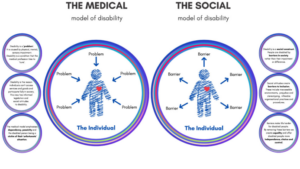
The experience of disability occurs when:
- people with impairments are excluded from places and activities most of us take for granted
- infrastructure and systems (the built environment) do not accommodate the diverse abilities and needs of all citizens.
- people’s attitudes prevent people with impairments from being able to participate in society on an equal basis with non-disabled people.
For example, where a person has a mobility impairment and is unable to climb stairs, rather than the focus being on trying to make them walk (which can cost significant amounts of energy and could potentially hurt or injure them), the focus is on making the world more accessible via ramps, accessible public transport, accessible facilities etc.
Impairment
An impairment can be intellectual, psychiatric, physical, neurological or sensory, and be temporary, intermittent or ongoing.
People may acquire an impairment through an accident or illness, and/or a person may be born with an impairment (congenital). Multiple impairments are common, especially with increasing age.
Impairments are often considered to be the disability. However, under the social model, there is a distinction between the two concepts.
Disability Strategy in New Zealand
About 1 in 6 New Zealanders are disabled. Whaikaha – Ministry of Disabled People lead a partnership between the disability community, Māori and the Government.
The New Zealand Disability Strategy 2026-2030 gives direction to government agencies on issues disabled people, tāngata whaikaha Māori and whānau say are important.
The new strategy includes:
- a vision and principles to set the direction for the strategy, and guide work across government for disabled people and tāngata whaikaha Māori
- 5 priority outcome areas of education, employment, health, housing and justice. Each has a goal and a set of actions to support the goal
- a monitoring approach to measure the government’s progress towards delivering the strategy.
Types of Disability Organisations in New Zealand
Disability Support Service Providers
These organisations deliver practical support to disabled people, such as:
- Daily living assistance – personal cares and household management
- Community participation support
- Respite and residential services
They may be government-funded or non-profit.
Disabled People’s Organisations (DPOs)
DPOs are led by disabled people and focus on advocacy, rights, and systemic change.
Examples include organisations represented by the DPO Coalition, which also participates in monitoring New Zealand’s obligations under the UN Convention on the Rights of Persons with Disabilities.
Current members of the DPO Coalition are:
- Disabled Persons Assembly NZ (DPA)
- Association of Blind Citizens New Zealand (Blind Citizens NZ)
- Balance Aotearoa
- People First
- Mana Pasefika
- Muscular Dystrophy Association of New Zealand
Disability Information Advisory Services (DIAS)
Provide independent information and advice to help disabled people navigate the disability system and provide support, workshops and/or seminars.
Condition or Impairment Specific Organisations
Support people with particular disabilities or health-related impairments (e.g. Blind Low Vision NZ, Autism New Zealand, IHC).
Services often include information, peer support, education, and advocacy.
Peer Support and Community Groups
Disability-led or community-based groups offering connection, mentoring, and shared lived experience.
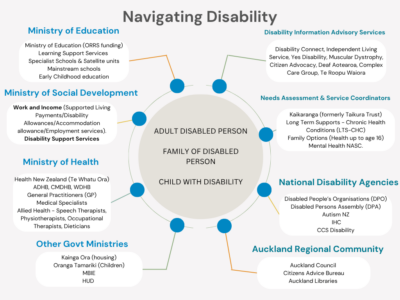
The Disability System consists of many organisations. To navigate the sector it is helpful to understand, which agencies operate under each of the Government Ministries. Below is a simple chart of some of the Ministries and organisations that you may interact with.